
German Health Minister Highlights Goals for WHO Hub by 2025
Mar 19, 2026
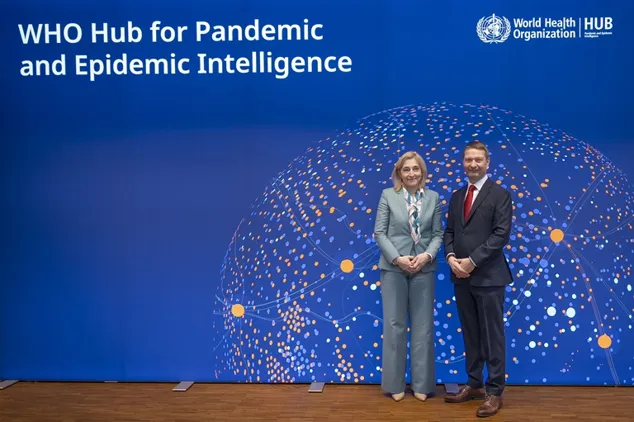
© WHO / Marcio Schimming Nina Warken, Germany’s Federal Minister of Health, and Dr. Oliver Morgan, Head of the WHO Hub for Pandemic and Epidemic Intelligence.
Germany’s Federal Minister of Health, Nina Warken, visited the WHO Hub for Pandemic and Epidemic Intelligence in Berlin today to mark the publication of the 2025 Annual Report. The report emphasizes progress in utilizing artificial intelligence, data science, and pathogen genomics to enhance global readiness for future pandemics.
In 2025, the WHO Hub in Berlin collaborated with more than 160 Member States and over 190 partners to assist countries and organizations in creating new systems and tools aimed at swiftly detecting and comprehending emerging public health threats, regardless of when or where they arise.
“Intelligent prevention means analyzing digital data on clusters of unusual cases of disease and symptoms in real time. In Germany, we are proud to host the WHO Hub for Pandemic and Epidemic Intelligence, a global center that uses artificial intelligence to detect, analyze, and effectively prevent potential epidemics," explained Federal Minister of Health Nina Warken during her visit. "Through its work, the Hub strengthens our health security and supports a rapid global response to epidemic threats.”
Artificial intelligence is increasingly transforming the detection of outbreaks. In 2025, the Hub launched an upgraded version of the Epidemic Intelligence from Open Sources (EIOS) system, which uses enhanced AI functions to scan global online information in real time and help experts quickly identify unusual health events. The system is now used by 120 countries.
To better anticipate health threats, countries need information beyond traditional health data. The Hub supports countries in implementing Collaborative Surveillance, which integrates data on climate, animals, travel, and population movement to provide a more comprehensive and real-time understanding of health threats.
The Hub also broadened global access to pathogen genomics, enabling scientists to identify new pathogens, including viruses and bacteria, and to understand their transmission and potential threat levels. With the International Pathogen Surveillance Network (IPSN), the WHO Hub in Berlin collaborated with 309 partners across 101 countries to enhance access to these technologies.
"We are in a new era of global health threats, and we need new tools to face tomorrow’s challenges,” said Dr. Chikwe Ihekweazu, Executive Director of the WHO Health Emergencies Programme. “The WHO Hub in Berlin helps countries use data and technology more effectively so they can identify risks earlier and respond faster. No country can address these threats alone. Strong cooperation remains our best defense.”
"Berlin offers an ideal environment for our work. We collaborate closely with world-leading institutions such as the Robert Koch Institute and the Charité Center for Global Health," said Dr. Oliver Morgan, Head of the WHO Hub for Pandemic and Epidemic Intelligence. "Germany has supported the WHO Hub since its establishment, and we are pleased to welcome Federal Minister Nina Warken to the Hub today. This strong partnership helps us advance innovation in pandemic and epidemic intelligence and better support countries to prepare for future health threats."
The Hub is enhancing the application of advanced analytics and mathematical modeling to predict how outbreaks might progress and evaluate which response strategies are most effective. Through its Collaboratory, the Hub links modelers and analysts with governments to ensure their efforts meet genuine public health requirements. By 2025, the community expanded to 1,300 members from 50 countries and 200 institutions. An AI-driven pandemic simulator, currently being prototyped, will assist decision-makers in comparing outbreak scenarios and identifying effective disease control measures.
#public health
#international collaboration



© 2025 Health Tribe.