
New study reveals drinking water does not prevent kidney stones
Mar 29, 2026
Author: Gao Jie
Reviewer: N/A
Curator: N/A
Production/Organizational Information: N/A
Severe abdominal and back pain, difficulty sitting or standing still, and even being unable to straighten up – this is the nightmare for many patients suffering from kidney stones. As one of the most common diseases of the urinary system, kidney stones are not only excruciatingly painful during an attack, but they also have a high recurrence rate.
For a long time, the advice to 'drink more water' has been regarded as the core principle for preventing the recurrence of kidney stones. But is this really supported by science?
On March 21, the prestigious medical journal The Lancet published the largest study to date on hydration interventions for kidney stones, which revealed that even when patients were encouraged to drink more water and increase their urine output, it did not reduce the recurrence rate of kidney stones.
The PUSH study (Prevention of Urinary Stones with Hydration) was conducted at institutions including Washington University in St. Louis, and involved 1,658 participants aged 12 and older with a history of urinary stones, all of whom had not met the 24-hour urinary output standard. Among these participants, 66.6% were individuals suffering from recurrent stones, who were troubled by frequent recurrences. The study lasted for a period of two years.
The study employed a 1:1 random grouping with a double-blind design throughout. A total of 826 participants were assigned to the intervention group, receiving multiple behavioral interventions, including personalized hydration prescriptions, health coaching, and assistance from smart water bottles, to comprehensively enhance their drinking adherence. Meanwhile, 832 participants comprised the control group, who received hydration advice based on clinical standards, without any additional interventions.
The core research observation indicator is the recurrence of symptomatic stones over a two-year follow-up period, specifically events involving the passage of stones, the need for surgery, or medical intervention for stones. Additionally, parameters such as 24-hour urine volume, changes in stone imaging, and adverse reactions will also be monitored.
Increased urine volume, but the risk of stone recurrence has not decreased.
After a median follow-up of 738 days (approximately 2 years), the study results showed that the 24-hour urine output in the intervention group was significantly higher than that in the control group, indicating that these interventions effectively helped patients increase their water intake, addressing the adherence challenge of 'not drinking enough water.'
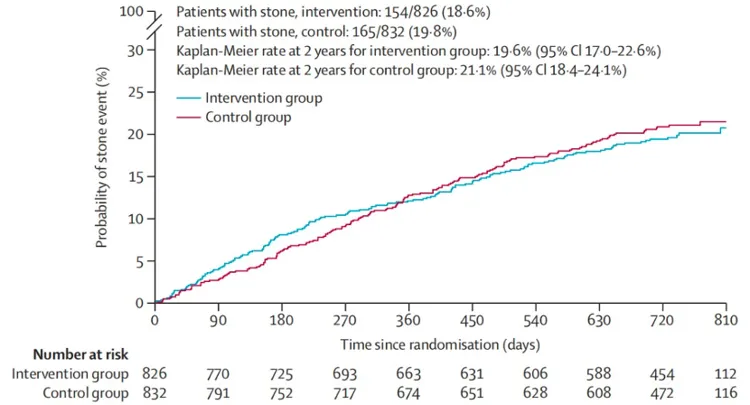
However, the most critical core result shattered traditional perceptions: the recurrence rate of symptomatic stones in the intervention group was 18.6% (154 individuals), compared to 19.8% (165 individuals) in the control group, with no statistical difference between the two groups. In simple terms, even though we successfully encouraged patients to drink more water and increase their urine output, the likelihood of stone recurrence did not decrease.
Moreover, the imaging examination results showed that there was no difference in the proportion of new stones and an increase of ≥2mm in existing stones between the two groups of patients.
In terms of safety, the study did not report any cases of hyponatremia (water intoxication) that required hospitalization throughout the entire intervention. Only 1% of the intervention group (12 individuals) experienced asymptomatic hyponatremia, compared to less than 1% in the control group (2 individuals). This indicates that the overall intervention plan is safe; however, it still did not provide benefits in preventing relapse.
You can't rely solely on 'drinking more water.'
It is worth noting that this study does not deny the role of drinking water, but rather overturns the conventional belief that 'drinking more water can prevent kidney stones,' while also providing important direction for clinical practice and future research.
The PUSH study clearly indicates that even if an increase in urine output is achieved, simply increasing fluid intake is insufficient to prevent the recurrence of kidney stones. This is due to the highly complex mechanisms involved in the formation of kidney stones, which are related to various factors such as the concentrations of calcium, oxalate, and uric acid in the urine, metabolic abnormalities within the body, dietary habits, and more. It cannot be resolved merely by diluting the urine.
For patients with kidney stones, ensuring adequate hydration in daily life remains fundamental, especially for those with extremely low urine output. Moderate water intake can alleviate urine concentration, but one must not place all hopes on simply 'drinking more water,' as excessive water consumption can increase the burden on the body. For patients who experience recurrent kidney stones, it is crucial to promptly investigate metabolic abnormalities and dietary patterns, and to follow the personalized guidance of a professional doctor, as this is key to preventing the recurrence of kidney stones.
This study serves as a warning for clinicians, indicating that in the future, more precise individualized interventions are needed, rather than simply advocating for 'increased water intake,' to help patients avoid the painful recurrence of kidney stones.
#health
#kidney health



© 2025 Health Tribe.