
Myopia surgeries needing corneal cross-linking reinforcement explained
Apr 09, 2026
Author: Zhang Jia, Liu Chang, Li Yini, et al. Reviewer: Xiong Jie, Zhang Chenxing, Wang Ke. Curator: Consensus on Expert Opinions for Corneal Collagen Cross-Linking in the Treatment of Ectatic Corneal Diseases (2023). Production/Organizational Information: Chinese Journal of Optometry and Visual Science, Journal of Third Military Medical University.
Title: Myopia surgeries needing corneal cross-linking reinforcement explained.
Introduction: Corneal cross-linking offers options for patients unsuitable for myopia surgery, enhancing understanding of surgical choices.
Keywords: ['Ophthalmology', 'Health'].
"Doctor, my cornea is relatively thin. Can I undergo laser surgery?" "Will the cornea continue to thin after the procedure?" During consultations for myopia surgery, the "safety" of the cornea is one of the primary concerns for patients. In recent years, "corneal cross-linking technology" has gradually gained public attention, acting like a "protective shield" for the cornea, allowing many patients who were previously unsuitable for surgery to consider lens removal. Today, let’s discuss which myopia surgeries require cross-linking and the core significance of this technology.
What is corneal cross-linking?
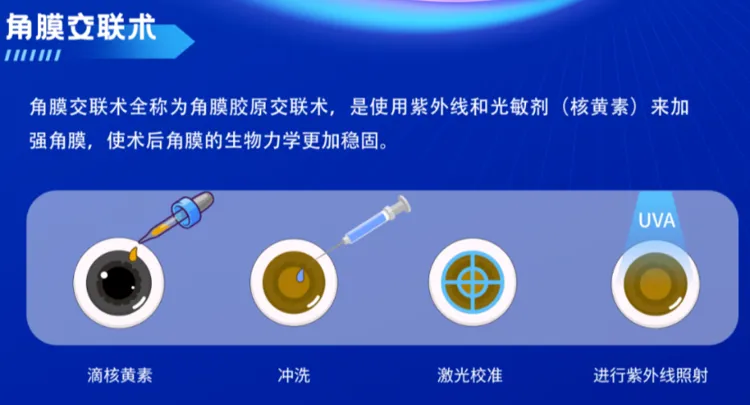
The principle of corneal cross-linking technology (CXL) is akin to strengthening the cornea: by using ultraviolet radiation or chemical induction, the collagen fibers in the corneal stroma undergo cross-linking reactions, forming a denser network structure that enhances the biomechanical strength of the cornea. In simpler terms, it is like transforming a loose mesh into a tough armor, thereby reducing the risk of corneal expansion and deformation post-surgery.
This technology was initially employed to treat keratoconus, a condition marked by corneal thinning and protrusion. It later progressively extended to the field of refractive surgery, particularly for patients with thin corneas and high myopia.
Which myopia surgeries require combined cross-linking?
Not all myopia surgeries necessitate cross-linking; however, certain circumstances may indicate its combined use.
High Myopia Laser Surgery
Patients with high myopia often require the removal of more corneal tissue, potentially resulting in the remaining corneal thickness approaching the safe lower limit (the international standard for remaining corneal stromal thickness is ≥280μm). In such instances, combining cross-linking technology can increase the biomechanical strength of the cornea and mitigate the risk of postoperative corneal ectasia.
Patients with thin corneas
The normal central corneal thickness is approximately 500-550μm. If preoperative corneal thickness is below 480μm, even with a low degree of myopia, the remaining corneal stroma may be inadequate after surgery. Cross-linking technology can help to alleviate the risks associated with insufficient thickness by providing a reinforcing effect.
Revision surgery for enhanced efficiency or those with irregular corneal morphology.
Some patients experience vision regression following the initial surgery and require a second enhancement procedure. Furthermore, individuals with minor corneal irregularities (such as a predisposition toward early keratoconus) can benefit from cross-linking technology, which enhances corneal stability and minimizes postoperative complications.
Corneal cross-linking technology is not universally applied to all myopia surgeries, but it has opened new avenues for lens removal for patients with poor corneal conditions. If you are uncertain about undergoing surgery due to thin corneas or high degrees of myopia, it may be beneficial to consult a specialist to assess whether combining cross-linking with the procedure is advisable—after all, safe clarity epitomizes the essence of lens-free freedom.
Interactive topic: Is there someone around you who has undergone myopia surgery? Are you familiar with corneal cross-linking technology? Feel free to share your thoughts in the comments!
Medical popular science is intended for reference only and should not be used as a basis for diagnosis or treatment!
Content source:
Consensus on Expert Opinions for Corneal Collagen Cross-Linking in the Treatment of Ectatic Corneal Diseases (2023).
Zhang Jia, Liu Chang, Li Yini, et al. Treatment of primary keratoconus with excimer laser therapeutic keratectomy combined with corneal collagen crosslinking. Chinese Journal of Optometry and Visual Science, 2018, 20(5):5. DOI:10.3760/cma.j.issn.1674-845X.2018.05.008.
Xiong Jie, Zhang Chenxing, Wang Ke, et al. Clinical observation of fully femtosecond small incision extraction of corneal stromal lenses combined with rapid corneal cross-linking in treating high myopia with thin corneas. Journal of Third Military Medical University, 2019, 41(24):7. DOI: CNKI:SUN:DSDX.0.2019-24-014.
#health
#ophthalmology



© 2025 Health Tribe.