
Four bad habits that can harm your child's eyesight this winter
Feb 08, 2026
Author: Unknown; Reviewer: Unknown; Curator: Unknown; Production/Organizational Information: Unknown. Title: Four bad habits that can harm your child's eyesight this winter. Introduction: Winter vacation poses a myopia risk; this article offers tips for parents to improve children's eye habits and care.
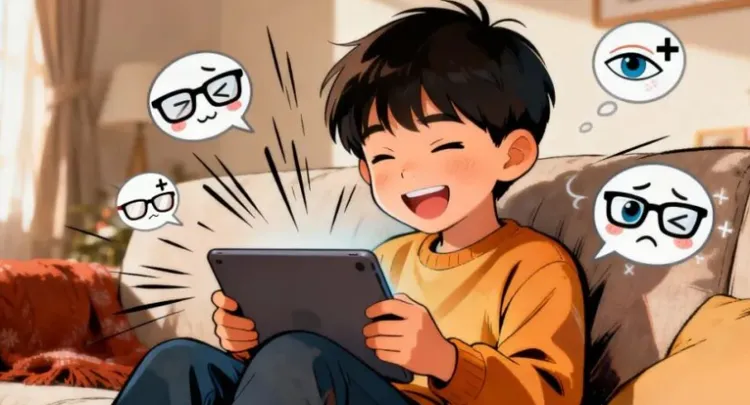
The winter vacation has arrived, and children can finally put down their backpacks and relax. However, parents need to be cautious—this is a high-risk period for the increase in children's nearsightedness! Many children go completely wild at home, writing homework with their heads tilted, getting very close to the tablet to see, and rubbing their eyes with dirty hands. These seemingly common little habits are quietly damaging children’s eyesight. Today, we will review four of the worst habits for eye health, along with some highly practical correction methods. Parents, make sure to keep this information handy!
Bad habit 1: Tilting your head while doing homework causes uneven pressure on the eyes, which can easily lead to distortion.
During the winter break, while doing homework and crafts at home, many children develop the habit of tilting their heads or lying down to read when no one is watching them. Don't think this only affects their spine; the damage to their eyes is even more direct!
Under normal circumstances, our two eyes work together in a division of labor, allowing us to see things clearly through the adjustment of the ciliary muscles. However, when tilting the head, the angle of vision differs for each eye, requiring one eye to work harder to focus properly. Over time, this can lead to a greater discrepancy in the degree of nearsightedness between the two eyes, a condition known as anisometropia. More seriously, tilting the head continuously exerts pressure on the eyeball, causing the cornea's curvature to become distorted, which not only worsens nearsightedness but may also induce strabismus, causing the child's eyes to appear increasingly crossed.
Correction tips.
It is essential for children to maintain the correct posture: keep the back straight, with the book or screen positioned 30 to 40 centimeters away from the eyes. They should avoid leaning their heads down or to the side for extended periods. Parents can set reminders at intervals or place a posture reminder note beside the desk.
Bad Habit 2: Looking at things too closely causes your eye muscles to become exhausted and stop working.
Whether reading books, looking at picture books, using tablets, or playing on phones, many children tend to get very close to the screen. When parents say something, they move back a bit, only to lean in again. This kind of close-range eye use is the number one culprit behind the worsening of nearsightedness!
Our eyes are like a precision camera, and the ciliary muscle acts as the muscle that adjusts the focus. When children look at things too closely, the ciliary muscle has to keep contracting with effort. Over time, it can become fatigued and go into spasm, unable to return to a relaxed state, resulting in a natural increase in nearsightedness. This is especially true during the winter break when children spend long hours glued to electronic devices, leaving the ciliary muscle no chance to rest. Is it any wonder that their vision worsens?
Correction tips.
Remember the 20-20-20 rule: every 20 minutes of studying, look up and gaze at something 6 meters away for 20 seconds to give your eyes a good rest.
Control screen time: Minors should not spend more than 4 hours on close-range eye activities each day, with total use of electronic devices not exceeding 1 hour daily, and each session lasting no more than 20 minutes.
Choose the right electronic devices: Try to use larger screens, such as TVs or tablets, and avoid letting children use smartphones for extended periods. Additionally, adjust the brightness and contrast properly—neither too bright nor too dark.
Bad Habit 3: Rubbing your eyes with your hands allows bacteria to sneak in and harm your eyes.
Children play with toys for a while and then reach for snacks, their little hands touching everything and getting covered in bacteria, yet they instinctively rub their eyes. Many parents think this is a minor issue, but it can actually be very harmful!
First, the bacteria and dust on the hands can be rubbed into the eyes, leading to conjunctivitis and keratitis. This may cause the child to experience redness, itching, and an increase in discharge from the eyes, and in severe cases, it can affect vision. Secondly, the pressure from rubbing the eyes directly compresses the eyeball, altering the shape of the cornea and worsening nearsightedness. If the child already has astigmatism, rubbing the eyes can further deepen the degree of astigmatism, complicating future correction.
Correction tips.
Develop the habit of washing hands frequently: After children play with toys or finish snacks, they must wash their hands carefully with hand soap and avoid letting dirty hands touch their eyes.
Timely management of eye discomfort: If a child experiences redness, pain, or light sensitivity after rubbing their eyes, do not administer medication on your own. Instead, promptly take the child for an eye examination.
Bad Habit 4: Doing homework in a dim environment causes your eyes to become overloaded and fatigued.
Some parents believe that it's sufficient for their children to just use a small desk lamp while doing homework at home. While some kids prefer to curl up on the sofa or in bed, reading and doing assignments under dim light. Little do they know that inadequate lighting is quietly draining their children's eyesight!
When the light is too dim, children will unconsciously lean closer to the book to see the text clearly. This causes the ciliary muscles to over-contract for adjustment, significantly increasing the strain on their eyes, which can easily lead to visual fatigue. Prolonged use of the eyes in a poorly lit environment not only causes myopia to progress rapidly but can also lead to symptoms such as eye strain, dizziness, and difficulty concentrating, ultimately affecting their learning efficiency.
Correction tips.
Create a scientific eye protection light source: Prepare a proper eye-care desk lamp for your child, placing it in front of and to the left of the desk to avoid direct light exposure to the eyes or reflections on the books. At the same time, turn on the main light in the room to create a dual light source of desk lamp plus main light, ensuring that the ambient light is ample yet soft. It is important to note that the main light source should have an illumination intensity of over 500 lux, with the desk area reaching between 500-1000 lux. During the day, you can open the curtains to let in natural light, but make sure to avoid direct sunlight hitting the eyes.
It is strictly prohibited to have inappropriate eye usage scenarios: Do not let children read or do homework on the sofa, bed, or under the covers. These places not only have insufficient lighting but also encourage poor sitting posture, posing a double threat to their vision.
During the winter vacation, parents should also take care of these three things for eye protection.
In addition to correcting bad habits, parents must take proactive measures to better protect their children's vision.
Two hours outdoors every day: Outdoor activities are a natural remedy for preventing myopia! During the winter break, take children to parks or the countryside for walks and sports. Letting their eyes be exposed to natural light can effectively slow the progression of nearsightedness.
Conduct a comprehensive eye examination: Take your child to a reputable ophthalmology institution for a check-up, which should include visual acuity tests and measurements of axial length. Ensure to perform Four Checks and One Record Keeping: check for hyperopia reserves (no more than 75 degrees for ages 6, 50 degrees for ages 7-8, 25 degrees for ages 9-10, and 0 degrees for ages 11-12; falling below these values indicates a risk of myopia), check for true and false myopia (false myopia shows no degree after dilation, and incorrect prescriptions can lead to true myopia), check the progression of myopia, and assess the risk of high myopia (be cautious if there is a family history of high myopia, if the child is myopic before school age, or if there is rapid increase in degree, as this may lead to complications such as glaucoma or cataracts).
Many children love playing with their phones because they learn it from their parents! During the winter vacation, parents should put down their phones and spend more time with their children doing parent-child games and outdoor activities. High-quality companionship should replace screen time to help children break free from their dependence on electronic devices.
The winter vacation is a time for children to relax, but don't let poor eye habits affect their eyesight! Parents, quickly refer to the methods above to help children correct bad habits and implement eye protection measures, allowing them to enjoy their winter holiday while also taking care of their windows to the soul. If you notice any abnormalities in your child's vision, be sure to seek medical attention promptly!
#children's health
#vision care



© 2025 Health Tribe.