
WHO Consultation Boosts Health Measures for Emergencies
Apr 02, 2026
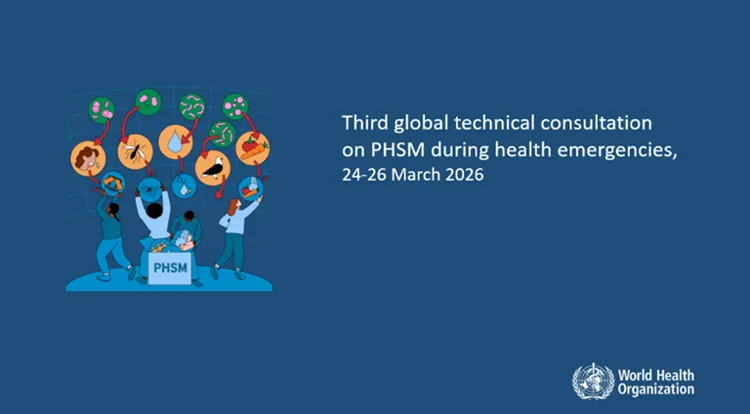
For its third global technical consultation on Public Health and Social Measures (PHSM) during health emergencies, held from March 24 to 26, the WHO gathered over 120 experts from 44 Member States. These representatives included members from ministries of health, national public health institutes, academia, as well as civil society and international organizations.
PHSM refers to nonpharmaceutical interventions that reduce the risk and scale of infectious disease transmission and lower the number of hospitalizations and deaths. Examples include symptom screening, personal hygiene measures, surface cleaning, vector control, modifications to gatherings, and domestic or international mobility. Therefore, PHSM plays a critical role in alleviating pressure on the health-care system during health emergencies, allowing time to develop and distribute vaccines and treatments, ultimately saving lives while protecting livelihoods.
From 4 a.m. in Mexico City to 9 p.m. in Sydney, global experts gathered with a common goal to enhance and expedite the evidence base regarding the effectiveness of PHSM, including unintended negative consequences and factors influencing adherence. They aimed to strengthen decision-making related to PHSM that is risk-based, informed by evidence, and equitable.
Taking Stock of Progress and Lessons Learned
The first day of the consultation centered on listening to updates regarding the initiatives undertaken by both countries and partner organizations to enhance Public Health Systems Management (PHSM) for preparedness and response to public health emergencies. Representatives from the Ministries of Health of India and Malaysia, the National Institute for Public Health and the Environment in the Netherlands, the University of Hong Kong, the European Centre for Disease Prevention and Control, the UK Health Security Agency, and WHO regional offices exchanged experiences.
Advancing the Effectiveness and Equity of Public Health and Social Measures (PHSM) Decision-Making in Diverse Contexts.
The second day focused on promoting equitable and context-specific implementation of PHSM. Experts explored how countries can select and adapt measures to their unique contexts, emphasizing that effectiveness depends not only on strong evidence but also on feasibility, public acceptance, and minimizing adverse health and socioeconomic impacts.
Experts were consulted on the advancement of:
- Operational guidance for implementing the WHO decision framework, PHSM Decision Navigator; - A PHSM Decision Navigator module on epidemic and pandemic influenza; and - Community-centered approaches to PHSM implementation.
This work is supported in collaboration with the Department of Epidemic and Emerging Infectious Diseases and the Department of All-Hazards Public Health Response of the UK Health Security Agency.
Strengthening the Evidence Base for Public Health and Social Measures (PHSM)
The third day concentrated on the implementation of World Health Assembly Resolution 78.3, which aims to strengthen the evidence base for PHSM. This resolution requested the Director-General to address methodological, legal, and ethical considerations to enhance research on PHSM. It also called for the development of flexible study protocol templates to measure the effectiveness of PHSM implementation, as well as the collation, review, and updating of best practices for research. Furthermore, the resolution emphasized the importance of supporting countries in monitoring any adverse consequences arising from the implementation of PHSM.
Experts contributed insights on:
- Master protocol templates utilizing the school reopening scenario and a user manual to adapt and conduct methodologically and publicly acceptable trials during and in anticipation of health emergencies; - Country-level best practices for monitoring social determinants of health and health equity, as well as real-time monitoring during health emergencies; and - The AI-powered PHSM Knowledge Hub, a comprehensive evidence base for PHSM policy and practice.
Looking Ahead
The consultation demonstrates a worldwide commitment to linking experience, evidence, action, and investment to enhance public health systems management (PHSM) research, decision-making, and implementation in preparation for and prevention of epidemics and pandemics. It showcases the unique role of the World Health Organization (WHO) in bringing together partners, establishing norms and standards, and offering guidance to countries.
The WHO PHSM Secretariat continues to make strategic investments to strengthen global and national capacities, enhance the rigor, comparability, and policy relevance of evidence, and provide robust guidance and resources for countries—translating normative leadership into sustained system-level impact, reinforcing PHSM as a strategic pillar for protecting populations and strengthening health emergency preparedness and response within, at, and across borders.
#public health
#international cooperation


© 2025 Health Tribe.