
Regional Simulations Boost Global Health Security Efforts
Jan 30, 2026
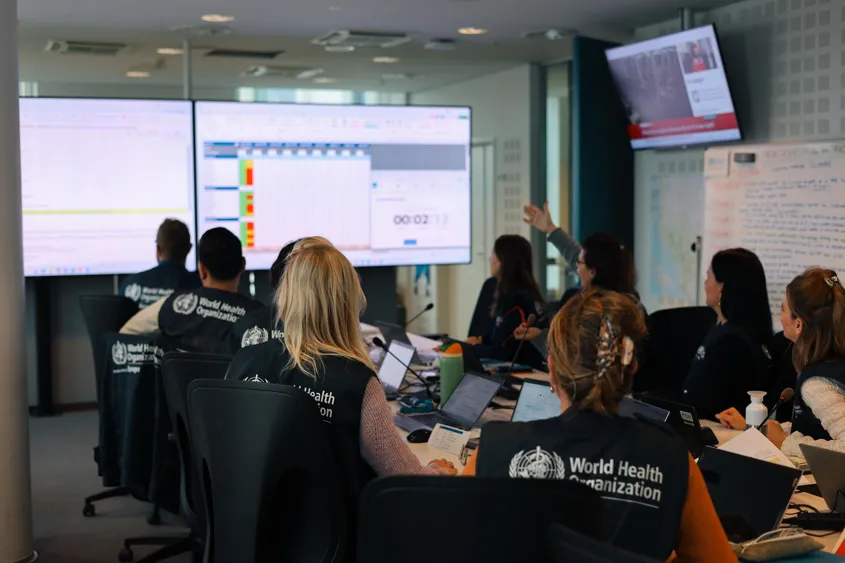
In 2025, countries across three WHO regions tested their International Health Regulations (IHR) capacities through region-wide simulation exercises, enhancing their capabilities to detect, report, and respond to public health threats with international implications.
These exercises – the South-East Asia Regional Practice of All-Hazard IHR Event Communications (SAPHIRE), the Joint Assessment and Detection of Events (JADE) in the European Region, and the IHR Exercise Crystal in the Western Pacific Region – unite National Focal Points (NFPs), who are essential in the IHR framework for protecting global health security. These annual exercises evaluate the IHR event communication procedures and contingency plans, showcasing a continuous commitment from countries to enhance preparedness and foster learning.
SAPHIRE 2025, held in July, brought together over 190 experts from 10 countries in the WHO South-East Asia Region to simulate a potential public health emergency of international concern stemming from a food safety incident. The exercise was conducted through email-based scenarios along with a virtual debriefing, aimed at evaluating the operational readiness of National Focal Points (NFPs) and International Food Safety Authorities Network (INFOSAN) Emergency Contact Points, as well as their communication with the WHO International Health Regulations (IHR) contact point in real time. Participants practiced implementing IHR Annex 2 and INFOSAN criteria, utilized institutional communication channels, and drafted essential documents related to the event. The exercise demonstrated improved clarity in roles, enhanced cross-sectoral coordination, and better access to the Event Information Site (EIS) – WHO’s platform that informs countries about significant public health events – compared to previous years. The structured self-review process of SAPHIRE and country-specific feedback reports will support targeted capacity-building initiatives throughout the region.
Dr. Buddha Nilesh, the Regional Emergency Director for WHO’s South-East Asia Region, emphasized in his closing remarks that “SAPHIRE 2025 marked a meaningful evolution by simulating a food safety-related event, reinforcing the linkage between IHR NFPs and INFOSAN ECPs. Participants demonstrated strong cross-sectoral coordination, flexibility, and improved clarity of roles under IHR.”
JADE 2025, which took place in November in the WHO European Region, brought together 41 countries and focused on improving communication and coordination between National IHR Focal Points (NFPs) and WHO IHR Regional Contact Points during a simulated chemical event with potential international ramifications. Through real-time functional scenarios, the participating countries practiced two-way notification and verification processes, utilized the IHR Annex 2 decision instrument, and engaged in posting on the Event Information System (EIS). The exercise also involved partners from chemical safety, environmental protection, civil defense, and laboratory sectors to evaluate mechanisms for requesting international assistance. Organized by WHO’s Health Security Division in collaboration with ECDC, DG SANTE, and RIVM, JADE 2025 enhanced both communication pathways and cross-sector collaboration, which are critical for effective responses to chemical emergencies.
"Simulation exercises like JADE offer a unique and safe environment for us to explore how our systems function under pressure. Through practicing and testing our capabilities, JADE contributes to strengthening our Region’s ability to respond swiftly and effectively to complex, multi-hazard events," says Ihor Perehinets, Health Security and Regional Emergency Director, Division of Health Security, WHO Regional Office for Europe.
In the WHO's Western Pacific Region, CRYSTAL 2025, which took place in December 2025, brought together 31 countries and areas to rehearse their readiness for the next pandemic through a simulated respiratory illness scenario. The exercise reinforced a culture of preparedness by testing real-time verification, information-sharing, and public health risk assessment processes. With a strong emphasis on operations at points of entry, it united health, animal health, and authorities responsible for points of entry, along with risk communications and other sectors, demonstrating the essential role of multisectoral coordination in managing emerging threats. Supported by the Pandemic Influenza Preparedness Framework Partnership Contribution, the exercise also assisted Member States in refining contingency plans, strengthening interoperability, and improving trust among agencies—critical elements for a rapid and coordinated emergency response. Additionally, based on scores from the IHR States Parties Self-Assessment Annual Reports, countries in the Western Pacific have noted increased scores for IHR National Focal Point capacities, including the timely sharing of information on acute public health events.
"Based on our experience with multiple health emergencies, we know that multisectoral coordination at points of entry is critical for effectively containing pandemics, especially at an early stage. In this regard, the scenario presented in this year’s IHR Crystal Exercise is appropriate," noted Dr. Shimoaraiso Makato, Public Health Advisor at the Asia-Europe Foundation. "While this year’s exercise focused on a novel influenza outbreak, the outcomes can also be applied to other priority hazards. We hope that the experience gained will be utilized in regional capacity-building efforts."
Together, SAPHIRE, JADE, and CRYSTAL 2025 Exercises demonstrate the value of regular, realistic simulation exercises in strengthening the global health security system. By testing communication systems, refining coordination across multiple sectors, and reinforcing the responsibilities of National IHR Focal Points, these exercises help ensure countries are better prepared, better connected, and more resilient when real emergencies arise.
#public health
#international cooperation



© 2025 Health Tribe.