
Is your vision struggling at work? Here's an emergency guide
Feb 24, 2026
Author: Jingcai Doctor; Reviewer: Ophthalmology and Optometry Experts; Curator: Jingcai; Production Information: Jingcai Doctor team consists of experienced ophthalmologists with master's degrees or higher, ensuring the accuracy of scientific content.
Title: Is your vision struggling at work? Here's an emergency guide
Introduction: Post-holiday, many face eye discomfort, known as 'visual fatigue syndrome.' Tips include the '20-20-20 rule' and hot compresses.
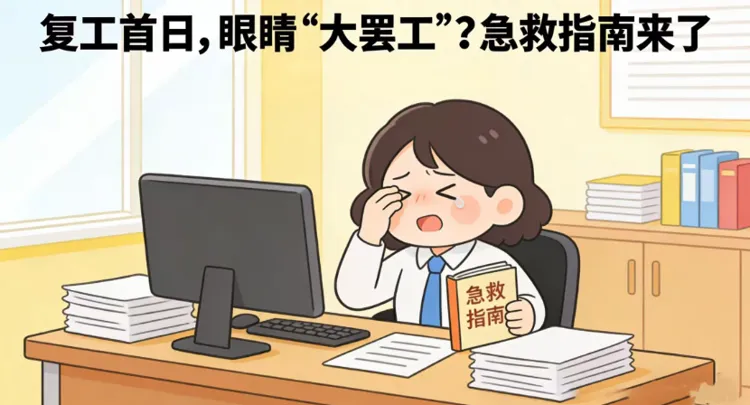
The hustle and bustle of the Spring Festival seems as vivid as ever, yet the alarm for work has cruelly gone off. As you drag your exhausted body to your workstation, you face a harsh reality: your eyes have surprisingly decided to 'go on strike' as well.
Staring at the computer screen, it takes less than ten minutes for discomfort to set in; despite having slept through the night, your eyes feel as dry as if sand had gotten in them, and as you look at densely packed tables, your vision begins to blur and lose clarity. Don't worry; this isn't just your problem. Today, let's discuss a quick guide to alleviating post-holiday 'visual fatigue syndrome' to help your eyes recover swiftly.
Why do our eyes react most intensely on the first day back at work? During the holiday, while we allowed our bodies to rest, we inadvertently worked our eyes even harder.
Staying up late to binge-watch shows until dawn: In a dark environment, focusing on the screen leads to increased blue light exposure, causing the frequency of blinking to plummet from the normal rate of 15-20 times per minute down to just 5-6 times.
Snatching red envelopes and scrolling through short videos: Prolonged close-up eye use keeps the ciliary muscles highly tense, like a spring that is constantly tightened.
Disrupted schedule: Staying up late decreases tear production, and with the dry air from indoor heating in winter, the eyes become more susceptible to dryness.
After accumulating fatigue throughout the holiday, it finally hits you all at once on your first day back at work as you face the computer.
What level of 'strike' status do your eyes belong to? Mild eye strain includes dryness, a feeling of a foreign body presence, and occasionally needing to blink hard to see the screen clearly.
Moderate strike: blurry vision, light sensitivity, heavy eyelids, and a noticeable sensation of difficulty keeping the eyes open in the afternoon.
Severe strain: Eyes feel swollen and painful, sometimes accompanied by headaches and nausea; it may take a few seconds to focus on nearby objects.
Regardless of the stage you find yourself in, the following urgent guide can assist you.
First Aid Guide: Conducting a 'Return to Work Health Check' for Your Eyes
First tip: The 20-20-20 rule (the simplest and most effective). Every 20 minutes of work, take a moment to look at something far away, about 20 feet (approximately 6 meters), for 20 seconds.
Why is it effective? Looking at something close causes the ciliary muscles in the eyes to contract and tense; gazing at something far allows these muscles to relax, akin to letting a tightly wound spring take a breather.
Tip: You can place a note next to your computer to remind yourself, or associate it with 'have a sip of water' or 'use the restroom' to prompt yourself to take action.
Second Tip: Active Blinking Training (Rescue for Dry Eyes). When you focus on the screen, you often 'forget' to blink, which leads to tear film breakage and your eyes being exposed directly to the air.
Instructions: Close your eyes for 2 seconds, tightly shut your eyes for 2 seconds, open your eyes for 2 seconds, and repeat this 5 to 10 times. This action can promote the secretion of oils from the meibomian glands, providing a 'protective film' over the tears to slow down moisture evaporation.
Third Method: Hot Compress First Aid (A Must-Do at Home). If your eyes still feel dry when you get home at night, warm compresses are the best physical remedy.
Method of operation: Use a warm towel or steam eye mask at 40-45℃ to apply on the eyes for 10-15 minutes.
Function: To clear the meibomian gland ducts in the eyelids and improve oil secretion, thereby alleviating dry eyes at the source. Note: Heat compresses are prohibited during acute conjunctivitis (pink eye).
Tip Four: Adjust Your 'Workspace Microenvironment.' Screen brightness should neither be too bright and blinding nor too dim and straining for the eyes. Adjust it to a brightness level similar to the surrounding ambient light.
Screen position: The eyes should be looking straight ahead or slightly downward at the screen, with a gaze tilted down by 15-20 degrees. This allows the eyelids to partially close, helping to reduce tear evaporation.
Humidifier: Place a small humidifier at your workstation or a cup of hot water to increase the environment’s humidity.
Fifth strategy: Dietary support. During lunch, you can specifically choose some eye-protective foods: Dark green vegetables such as spinach and kale, which are rich in lutein.
Orange and yellow fruits like oranges and blueberries, providing vitamin C and anthocyanins.
Warm water: When the body is dehydrated, the eyes are the first to notice. Drink less coffee and more water.
When should you go to the hospital? Although most post-holiday eye fatigue can be relieved through rest, if the following conditions occur, please seek medical attention promptly: unbearable swelling and pain in the eyes, accompanied by headache on the same side, nausea, and vomiting.
A sudden decline in vision, and inability to recover after resting.
Experiencing numerous floating spots in front of your eyes, sometimes accompanied by a flashing sensation.
Redness and swelling of the eyes, with increased secretion.
Written at the end. On the first day back to work, don't just consider giving your body a transition period; also let your eyes adjust and gradually get back into the groove.
After all, maintaining good eyesight will make the work in the coming year feel more vibrant.
Starting today, reduce late nights and focus on looking into the distance more frequently. Your eyes deserve kind treatment.
---
For more ophthalmology-related popular science, you can follow Tejingcai.
#health
#lifestyle

© 2025 Health Tribe.