
Local Data Boosts Malaria Elimination Efforts in Africa
Feb 27, 2026
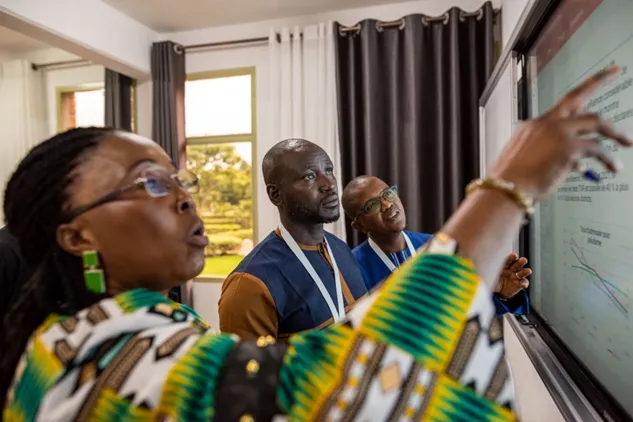
For a health facility in northern Togo, effectively analyzing and utilizing routine surveillance data can make the critical difference between early identification of a surge in malaria cases and recognizing it only when wards are overwhelmed and children present with severe symptoms. In malaria programs throughout Africa, the capacity of health workers to comprehend and act upon data directly influences who receives timely care. However, health workers in the region are increasingly expected to analyze trends and guide responses using routine data, often with limited access to advanced, practical training that aligns with their language, context, and analytical needs. When learning opportunities are not accessible or contextualized, data may be gathered but not fully utilized for decision-making. To tackle this issue, the World Health Organization (WHO) developed the course "Malaria: Harnessing the Power of Routine Health Facility Data," making it available in English, French, Spanish, and Portuguese through the WHO Academy online learning platform as part of a blended learning program. Led by Dr. Deepa Pindolia, this course was designed from the beginning with localization as a fundamental principle, acknowledging that data analysis is inherently complex, and learning in a second or third language can be ineffective. Dr. Atekpe Payakissim Somiabalo, the National Malaria Control Programme (NMCP) Coordinator in Togo, emphasized the importance of training in French. “The main priority is training operational staff in a language they understand so that everyone recognizes the significance of the data collected for decision-making.” According to the NMCP, malaria remains the leading cause of illness in Togo, accounting for 30% of outpatient consultations, 9% of hospitalizations, with over 2.18 million cases and 993 deaths reported in 2024. When asked if he would recommend the course to colleagues involved in malaria elimination efforts, Dr. Somiabalo was enthusiastic. “Yes, yes, and yes. Any effective intervention to combat a specific disease relies on a robust surveillance system. We need to develop contextualized operational action plans to address the identified problems and enhance coverage and performance indicators.” In Senegal, Mr. Médoune Ndiop, a specialist in monitoring, evaluation, and surveillance within the NMCP (2002-2025) and co-chair of its working group (2018-2024), echoed this sentiment, highlighting the significance of localized, contextualized, and accessible learning for health care workers at various levels of the health system. “It increases participants' understanding and ensures they have a better grasp of concepts,” he remarked. “Using the local official language facilitates interactions with participants, particularly in analysis and interpretation exercises.” Thibaud de Chevigny, a malaria expert and facilitator of the course, has observed this transformation across Africa. After more than a decade of supporting malaria programs in the region, he believes localization is not merely an option—it is foundational. “Translation is absolutely essential because most subnational program teams and health information officers in Africa do not work in English,” he stressed. “When people can learn in their own language, the concepts become clearer, the training is more inclusive, and it also creates greater opportunities to disseminate the learning.”
For de Chevigny, all training should be fully localized and adapted to the context. “Beyond translation, the real impact comes when the course is localized to reflect each country’s context. I’ve seen how participants become much more engaged when we use local epidemiological data or case studies. Suddenly the discussions shift from theory to their daily reality.”
This approach is crucial in a region that bears the brunt of the global malaria crisis. According to the World Malaria Report 2025, 94% of malaria cases worldwide were reported in the WHO African Region in 2024. Of the 610,000 malaria-related deaths, 95% occurred in the WHO African Region, with three-quarters of those deaths among children under five years old. As de Chevigny points out, routine surveillance is fundamental for effective malaria control, especially in an era marked by increasing insecticide and drug resistance, climate change, and dwindling funding, which makes data-driven decision-making more vital than ever. “My main hope is that healthcare workers will leave with the confidence to use surveillance data as a powerful tool for decision-making in their daily activities. I want them to understand that their role at the frontline is essential in reducing the burden of malaria, and that they are equipped with both the knowledge and the practical skills to make a tangible impact.”
#public health
#health equity


© 2025 Health Tribe.