
New study reveals how mental stress weakens anti-cancer defenses
Feb 09, 2026
Author: Zhang Bing, Zhou Ting. Reviewer: Westlake University. Curator: Westlake Laboratory. Production/Organizational Information: Westlake University.
After working late into the night, stress pimples appear on my face; after arguing with family, I feel a faint discomfort in my stomach. We often sense the marks that emotions leave on our bodies.
Recently, a research team from Westlake University revealed a more crucial factor behind this issue. Prolonged mental stress can compromise the fighting ability of your body’s anti-cancer patrol, allowing abnormal cells to take advantage. On January 30, teams led by Zhang Bing and Zhou Ting from Westlake University and Westlake Laboratory published their joint research findings in the prestigious international academic journal Cell.
In our body, the surface tissues such as skin and respiratory tract are home to an important immune patrol – CD8⁺ TRM cells. They function like security guards at the door, ready to detect and eliminate cancerous cells at any moment.
The research team discovered through mouse experiments that when under stress, the body’s sympathetic nervous system becomes overly active and rapidly downregulates epithelial CXCL16. This weakens the supply of circulating T cells to the skin, leading to a decrease in the number of intraepithelial CD8⁺ TRM cells.
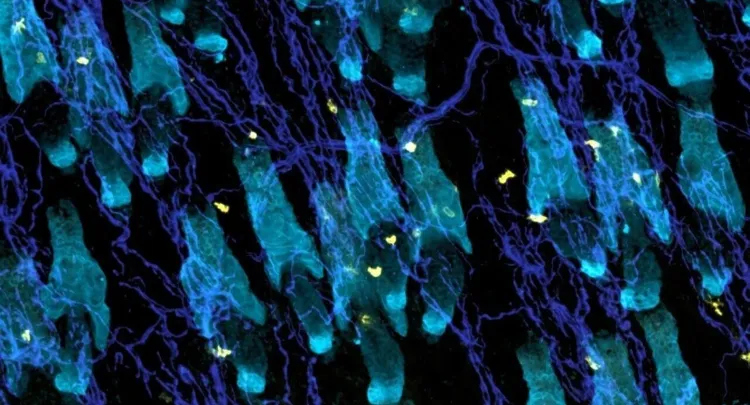
The epidermal structure of the cyan-colored hair follicles in the mouse skin is surrounded by a dense network of blue sympathetic nerve fibers, interspersed with yellow CD8⁺ TRM cells. (Image credit: West Lake University)
The decrease in the number of immune patrols naturally leads to a temporary low alert window in local immune surveillance: viruses can more easily replicate, and early abnormal cells are also more likely to evade timely elimination, thereby accelerating tumor progression.
All of this originally stemmed from an unexpected discovery in an experiment.
Assistant Professor Zhang Bing from the School of Life Sciences at Xihu University observed that in mice, if certain pressure nerves in the skin are cut, the early development of skin cancer actually slows down. Are these nerves tripping up the immune system? This intuition led him to collaborate with Zhou Ting, who specializes in immune research. Together, the two scientists embarked on a continuous exploration that ultimately uncovered this series of immune mechanisms.
Research team, from left to right: Zhou Ting, Miao Jujun, Zhang Peng, Zhang Bing. Photo provided by Westlake University.
When the immune defenses weaken, if there happen to be cells beginning to undergo cancerous changes, they may evade detection and grow quietly. This window of defense weakness, resulting from stress, becomes a dangerous stage for cancer to lie dormant.
It is often said that long-term stress harms the body. This research not only validates the intuition that the body and mind are interconnected, but also serves as a reminder for us:
Properly regulating emotions and managing stress is not just for the sake of a good mood—it’s also about stabilizing the cancer-fighting patrol within the body.
Sometimes, taking a break can truly be a lifesaver.
#health
#research


© 2025 Health Tribe.