
What is the link between ancient roof designs and climate change?
Apr 05, 2026
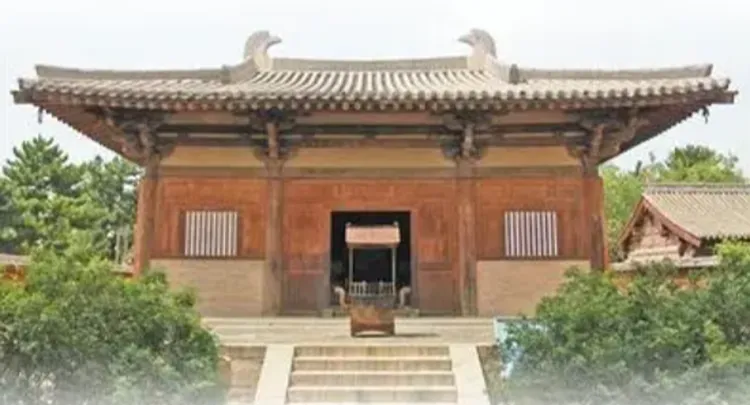
Author: People's Daily Editor: Zhen Xi Proofreading: Xu Lai, Zhang Linlin Title: What is the link between ancient roof designs and climate change? Introduction: A study reveals ancient Chinese roofs were adapted to climate, enhancing safety and reducing costs by adjusting slope for snow. Keywords: ['Architecture', 'Climate'] Main text: From the Tang Dynasty to the Ming and Qing Dynasties, ancient Chinese people continuously adjusted the slope of building roofs to better adapt to the local climate environment. This was done to cope with century-scale changes in snowfall brought about by climate variations, ensuring the safety of the buildings and reducing maintenance costs.
What is the relationship between the design of ancient building roofs and climate change? This ongoing research topic has been consistently studied by Fu Zongbin's team from the School of Atmospheric Sciences at Nanjing University, an academician of the Chinese Academy of Sciences, in collaboration with Ge Quansheng's team from the Institute of Geographic Sciences and Natural Resources Research at the Chinese Academy of Sciences. The slope of rooftops is negatively correlated with the average temperature during the winter months in the eastern and central regions of China. During colder periods, the roofs become noticeably steeper; in warmer periods, the slope of the roofs significantly decreases. However, once the 'roof height-to-span ratio', reflecting the slope of the rooftop, reaches approximately 23%, it has never fallen below this value again, explained Li Siyang, an associate professor at Nanjing University’s School of History and a member of the research team.
Consideration of the functional requirements of the buildings is essential when analyzing these changes in roof slope. The architecture of the Tang Dynasty is characterized by spaciousness and openness, while that of the Song Dynasty is renowned for intricate and delicate designs. Ming and Qing Dynasty architecture features steep and elaborate structures. As Chinese architecture evolved through different periods, the changes in the slope of roofs, whether steep or gentle, have also drawn the attention of the research team. They question, "What factors have driven these changes in roof slopes?"
Earlier, some senior scholars discovered in their studies on ancient architecture that from the Tang to the Ming and Qing Dynasties, the overall trend of roof slopes became steeper, increasing from about 20% in the 8th century to approximately 35% in the 18th century. Traditional architectural history studies typically explore differences in roof slopes of buildings across different eras through the lenses of architectural technology advancement and aesthetic style evolution.
However, architecture strongly relates to residential needs, leading the research team to wonder whether the evolving architectural styles were influenced by the buildings' functional requirements. After raising this question, they commenced their investigation.
During the research process, an interesting phenomenon emerged: the Longmen Temple in Ping-shun, Shanxi, retains architectural relics from the Five Dynasties through the Ming and Qing periods. The Daxiong Baodian, constructed during a cold period in 1098, and the East Hall, built between 1498 and 1504, exhibit steeper roofs with pitches of 29.67% and 30.50%, respectively. In contrast, the Tianwang Hall, built during the warmer period from 1271 to 1294, has a gentler slope with a pitch of 26.92%.
Team members are engaged in discussions. Photo provided by the interviewee. "Our goal is to comprehend this phenomenon from a climatic perspective," explained Ding Ke, a tenure-track assistant professor at the School of Atmospheric Sciences at Nanjing University.
To validate this climate change hypothesis on a millennial scale, existing sequences of ancient building slope changes or meteorological data are lacking. The team compiled data on over 200 official buildings in northern China with clear survey records from the Tang to the Ming and Qing Dynasties. They established a database of the roof height-to-span ratios of these ancient structures and gathered historical climate change data for further analysis.
Statistics indicate that changes in roof slope over time exhibit a fluctuating upward trend on a century scale, with smaller roof slopes during warm periods and larger slopes during cold periods.
The relationship between slope and historical climate change has been organized.
Discoveries have been made regarding the motivation for snow removal on steeper roofs.
Among the numerous meteorological factors, deciding which specific elements to focus on for research has become a critical consideration.
What is the impact of changes in the slope of roofs—are they influenced by wind, rainfall, or snowfall? "Wind? In a closed structure, changes in the roof slope have limited effects on indoor air temperature." "Rainfall? Well, during warm periods, if rainfall increases, the roof should become steeper to enhance drainage capacity, which conflicts with the observed trend."
After several discussions, some assumptions were dismissed; ensuring the roof's snow removal capacity emerged as the most plausible explanation.
Since most surviving architectural remains are located in semi-arid and semi-humid regions of central and eastern China, where winter is relatively cold with substantial snowfall, it is speculated that facilitating quick snow sliding off roofs to prevent structural damage could significantly influence roof design. To confirm this hypothesis, it will be necessary to investigate ancient texts for snowfall records during colder climates with steeper roofs to ascertain if more frequent and extreme snowfall occurred during those times," Ding Ke explained.
Based on this data, the team further combined modern meteorological data, historical temperature reconstructions, and archaeological information to reconstruct changes in snowfall in eastern and central China over the past millennium. They simulated roof slope changes necessary to adapt to variations in snowfall. Results revealed that ideal roof slope changes inferred from snowfall amounts closely align with changes observed in historical architectural remains over the past millennia.
This suggests that snowy weather likely has a significant impact on the design of traditional Chinese architecture, explained Ding Ke.
A large body of materials was consulted.
Research on the Adaptation of Architectural Forms to Climate Change.
During their study, the team also discovered a fascinating observation: ancient buildings constructed before the year 940 have systematically shallower roof slopes compared to those erected in later periods. For instance, the western annex of the Longmen Temple, completed in 925, within a cold climatic period similar to the Ming and Qing dynasties, exhibits a less pronounced roof slope than those constructed later. This suggests that builders during colder periods sought to adjust roof slopes through technical alterations driven by heightened snow removal demand.
An intriguing instance of this phenomenon is observed in the roof span ratio, which developed from 19.24% in the South Zen Temple of Mount Wutai in 782 to 29.67% in the Longmen Temple of Pingjun in 1098. Construction-related changes indicate that components within the building’s roof and beam framework underwent relative positional shifts, changing the lowest beam position relative to the eaves beam. Although these structural changes correlate to the broader development of ancient wooden architecture, their objective effects were conducive to constructing steeper roofs.
The research team examined ancient architecture in Wutai Mountain, Shanxi. Photo by Shu Jinqi.
Furthermore, from the mid to late Ming Dynasty, during the Little Ice Age of the Ming and Qing dynasties, a new roof curve design method known as the "jiajia method" began to emerge, gradually gaining widespread use. Roof slopes designed with this method were further increased, and by the 1830s, it was incorporated into official architectural regulations, becoming the standard for official building roofs.
Through this research, it becomes evident that builders throughout Chinese history appear to have adapted to climate change by modifying architectural forms and technologies, said Li Siyang.
Based on interdisciplinary research on climate and ancient architecture, the team published a new study in 2025, tackling the "mystery of the development of dougong during the Six Dynasties period." This study investigates the reasons behind the decline of dougong forms that extend to support eaves during the Three Kingdoms, Two Jins, and Northern and Southern Dynasties.
Due to the absence of wooden structure examples from before the Tang Dynasty in China, the research team compiled approximately 250 architectural visual materials. By integrating temperature reconstruction data and related ideal experiments, they discovered that deep eaves supported by bracket sets significantly reduce the intensity and duration of sunlight received by buildings. Additionally, during the period of the Three Kingdoms, Jin, and Northern and Southern Dynasties, the overall climate was relatively cooler, leading to an increased demand for warmth among residents through solar radiation, consequently driving a design trend towards shorter eaves in architecture. Thus, the climatic context may provide potential explanations for the decline of eave forms supported by brackets.
The wisdom embedded in ancient architecture remains largely unexplored, and climate change presents a new avenue for observation. The research team indicated that they are extending this perspective to wider and more diverse studies in archaeology.
Planning and Production.
#architecture
#climate



© 2025 Health Tribe.